What Is a Gothic Graphic Novella? | Curator of Woe
Learn what makes a Gothic graphic novella different from a comic, poetry book, or traditional horror story through the world of Curator of Woe.
2 min read
What Is a Gothic Graphic Novella?
A Gothic graphic novella is not quite a comic book, not quite a poetry collection, and not quite a traditional horror story.
It lives somewhere between image, verse, atmosphere, and shadow.
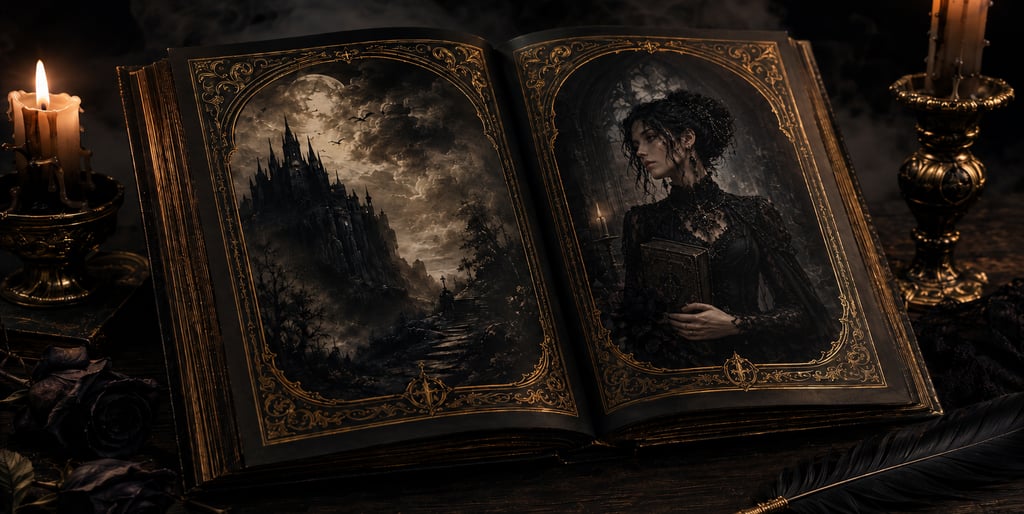
The word “graphic” points to the visual nature of the work. The story is not carried by words alone. Images matter. Borders matter. Color matters. A hallway, a candle, a raven, a chain, a tear, or a chamber can speak as strongly as a sentence. The artwork does not merely illustrate the writing. It deepens it.
The word “novella” suggests something shorter and more focused than a full-length novel. A novella does not need to explain an entire universe at once. It can enter one emotional passage, one spiritual struggle, one symbolic place, and explore it with intensity. It can be concentrated, poetic, and haunting.
The word “Gothic” brings the atmosphere.
Gothic storytelling often lives in shadowed spaces: ruined halls, locked rooms, ancient houses, graveyards, storms, secrets, curses, and memories that refuse to die. But Gothic work is not only about dark scenery. At its deepest, it is about the inner life of fear, guilt, grief, longing, and spiritual unease.
A Gothic graphic novella brings these elements together.
It gives the reader a story that is visual, literary, emotional, and atmospheric. It may not move like a superhero comic or a fast-paced thriller. It may move like a candle flame in a cold room. Slowly. Uneasily. Beautifully. With the sense that something unseen is near.
The Curator of Woe Gothic graphic novella series belongs to this darker form of illustrated storytelling. Its pages are designed to feel like entries in a sorrowful ledger, passages from a haunted spiritual record, or fragments recovered from a world where Woe has become visible.
The writing is poetic. The images are symbolic. The tone is Gothic, sorrowful, and mysterious.
This means the reader is not only following events. The reader is entering an atmosphere. Each page is meant to be experienced, not rushed. A single image may suggest judgment, memory, remorse, imprisonment, prayer, fear, or the ache of a soul unable to escape its own past.
Unlike ordinary horror, a Gothic graphic novella does not depend only on shock. It may contain darkness, dread, and frightening images, but its deeper power comes from what lingers afterward. The question is not only, “What happened?” The question becomes, “What does this sorrow mean?”
In the world of the Curator of Woe, the answer is rarely simple.
The Curator appears as a witness to this sorrow. Her presence connects the poetic and visual pieces into a larger world. She reminds the reader that Woe is not random. It has a record. It has symbols. It has chambers, paths, trees, ledgers, and names.
A Gothic graphic novella invites the reader to step into that record.
It is a form for those who want darkness with beauty, horror with meaning, and poetry with images strong enough to haunt the page.
Discover a darker form of illustrated storytelling through the Curator of Woe.