
The Tree of Woe: Sorrow, Memory, and Lost Souls | Curator of Woe
Explore the Tree of Woe, a dark Gothic symbol of sorrow, memory, grief, lost souls, and spiritual consequence in the world of the Curator of Woe.
2 min read
The Tree of Woe: A Symbol of Sorrow, Memory, and Lost Souls
In the world of The Curator of Woe, sorrow does not always remain hidden within the heart.
Sometimes it takes root.
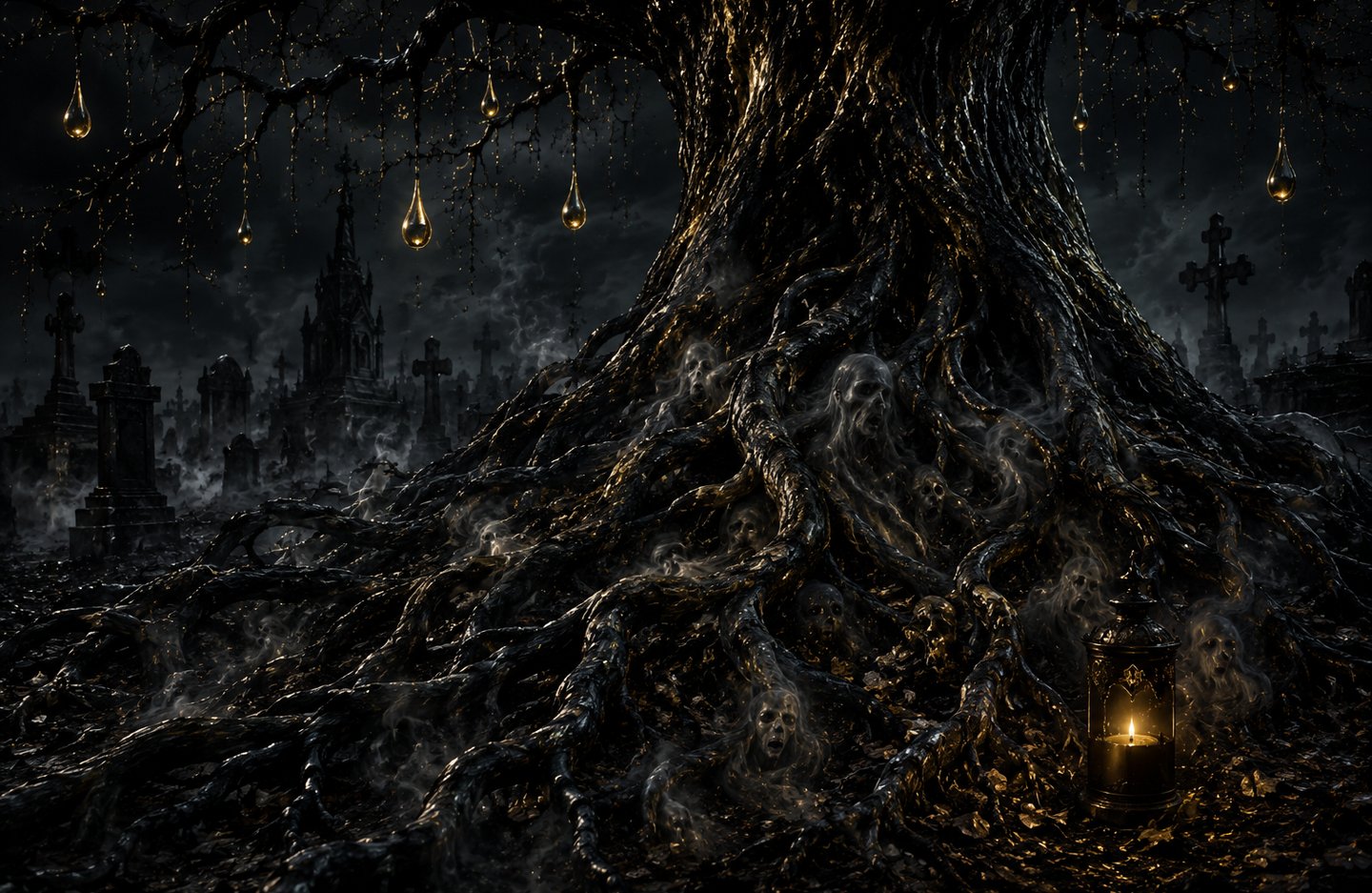
The Tree of Woe stands as one of the darkest and most powerful symbols in the Curator’s universe. It is not merely a tree in a cemetery. It is a living emblem of grief, consequence, memory, and the suffering souls that have become tangled in what they could not escape.
Its roots descend into sorrow.
Its limbs carry the weight of mourning.
Its branches hold tears like fruit.
The Tree of Woe is a place where grief becomes visible. It suggests that pain, when buried too long, does not vanish. It grows beneath the surface. It twists through memory. It feeds upon loss, regret, longing, and the wounds that time has failed to heal.
This is why the Tree is so central to the Gothic world of the Curator.
Gothic storytelling has always understood that landscapes can reveal the soul. A ruined hallway may represent a life broken by fear. A locked chamber may hold shame. A candle may stand for hope struggling against darkness. In the same way, the Tree of Woe becomes more than scenery. It becomes a spiritual landmark.
It is the place where sorrow has been rooted into the earth.
The image of lost souls caught in its roots speaks to a deeper truth. Some suffering does not pass easily. Some souls remain bound to memory, guilt, grief, or consequence. They are not forgotten by the Tree. They are held by it. Their anguish becomes part of its growth, part of its shadow, part of its terrible beauty.
The tears hanging from its limbs are equally important. Tears are signs of pain, but also signs that the soul has not become entirely stone. A tear may hold remorse. It may hold love. It may hold repentance, longing, or the final trace of a hope that has not fully died.
In this way, the Tree of Woe is both dreadful and deeply emotional.
It does not offer easy comfort. It does not pretend sorrow is harmless. Yet it also does not treat grief as meaningless. Every root, every limb, every tear, and every trapped soul suggests that pain has a record. It has shape. It has testimony.
The Curator of Woe is drawn to such places.
She does not stand before the Tree as its master. She does not command its branches or release every soul from its roots. She witnesses what has gathered there. She understands that Woe, once rooted deeply enough, becomes part of the landscape of the spirit.
The Tree of Woe also reflects the larger vision behind the Curator’s world. This is a universe where darkness and beauty are never far apart. The macabre is not used only to shock. It is used to reveal. It allows grief, loss, and spiritual struggle to appear in forms the reader can see and feel.
A tree becomes sorrow.
A root becomes memory.
A tear becomes testimony.
A cemetery becomes a record of what the soul has carried.
For readers entering The Curator of Woe Gothic graphic novella series, the Tree of Woe offers an important key to the world. It tells us that Woe is not a passing mood. It is ancient, rooted, and alive with memory. It reaches downward into what has been buried and upward toward what still mourns.
The Tree stands because sorrow remains.
The Curator watches because sorrow must be remembered.
And somewhere among its roots, the lost still wait to be seen.