The Ouroboros: Rebirth, Eternity, and Gothic Symbolism | Curator of Woe
Explore the Gothic meaning of the Ouroboros, the ancient serpent of eternity, destruction, rebirth, and its connection to the Curator of Woe.
3 min read
The Ouroboros: The Serpent of Rebirth, Ruin, and Woe
Few symbols are as ancient, haunting, and spiritually charged as the Ouroboros.
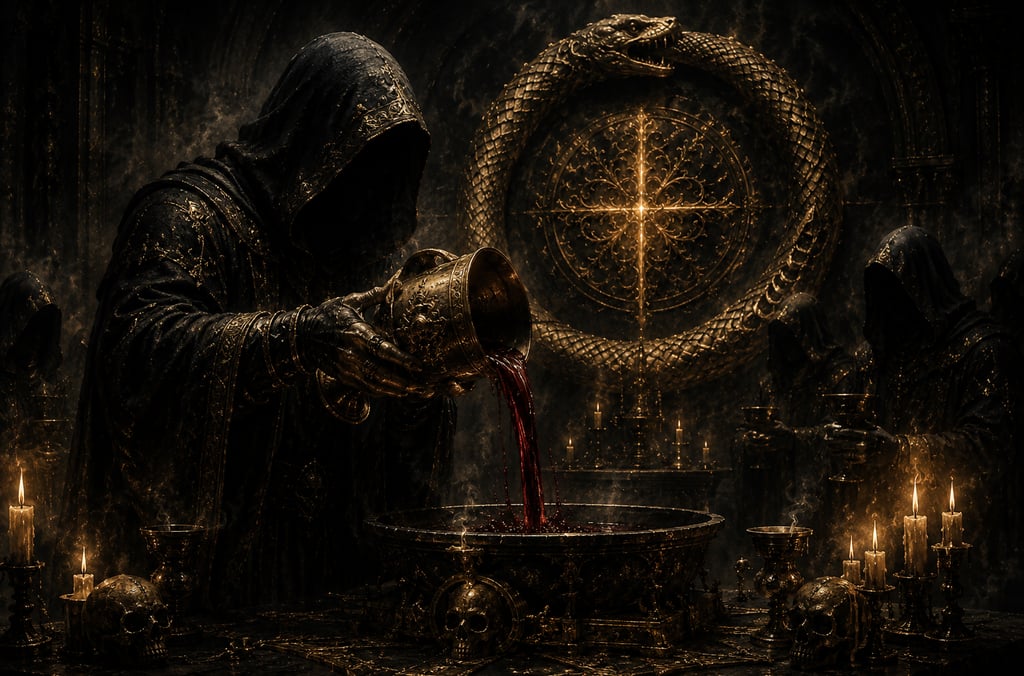
A serpent devouring its own tail, the Ouroboros forms a circle without visible beginning or end. It is both creature and cycle, hunger and completion, destruction and return. At first glance, the image may seem monstrous: a serpent consuming itself. Yet beneath that dreadful image lies one of the oldest symbolic ideas known to human imagination — that endings are never merely endings.
What dies may return.
What is consumed may be transformed.
What is destroyed may become the beginning of something else.
The Ouroboros has appeared across ancient Egyptian, Greek, Gnostic, Hermetic, and alchemical traditions. It has been used to suggest eternity, unity, the circular nature of time, the joining of opposites, and the endless rhythm of death and rebirth. It is a symbol of recurrence: the world devouring itself and remaking itself, the soul confronting its own shadow, the past returning in another form.
For this reason, the Ouroboros belongs naturally within the Gothic imagination.
Gothic symbolism is rarely simple. A candle is not merely a candle. A locked door is not merely a door. A serpent swallowing its own tail is not merely a creature of fear. It is a warning that what is unresolved may return. It is a reminder that sorrow can circle back upon itself. It is an emblem of the soul trapped inside a cycle it cannot break.
In the world of The Curator of Woe, this symbol takes on a darker and more sorrowful meaning.
The Ouroboros does not only represent life continuing. It can also represent Woe continuing. A soul may believe one torment has ended, only to find that the same anguish has returned in another shape. Regret becomes memory. Memory becomes burden. Burden becomes consequence. Consequence becomes Woe. The circle closes, and the suffering begins again.
This is where the symbol speaks powerfully to a line from Chamber of Woe:
“Sanguine feast hosted by mystics empties Chalice of Rebirth. I become the Woe that cannot die.”
The Chalice of Rebirth suggests renewal, but in the shadowed world of Woe, rebirth is not always release. To be reborn without redemption may be to continue in sorrow. To become “the Woe that cannot die” is to enter a terrible cycle: not life restored in peace, but anguish preserved beyond its natural end.
The Ouroboros becomes the perfect emblem for that condition.
It is the serpent of return.
It is the circle of consequence.
It is the ancient sign that what feeds upon itself may still endure.
In alchemical symbolism, the Ouroboros often suggests transformation — the breaking down of one state so another may emerge. Yet Gothic storytelling asks a more troubling question: What if transformation is refused? What if the soul circles its own wound, devouring memory but never healing from it? What if rebirth occurs, but mercy does not?
Then the Ouroboros becomes not only a symbol of eternity, but a symbol of imprisonment.
This dual nature is what makes it so powerful. It can represent hope or horror, renewal or repetition, sacred unity or spiritual entrapment. It can show the path of the soul toward transformation, or the doom of a soul that cannot escape itself.
Within The Curator of Woe Gothic graphic novella series, the Ouroboros may be understood as a symbol of sorrow that returns until it is witnessed, named, and brought before the possibility of redemption. The Curator does not break every circle. She does not silence every serpent. But she sees what others ignore. She records what time tries to bury.
The Ouroboros reminds us that no sorrow disappears simply because it has been hidden.
It waits.
It coils.
It returns.
And in the world of Woe, every return has a record.
The serpent bites its tail. The chalice is emptied. The soul is changed. And somewhere in the shadows, the Curator watches as the ancient circle closes once again.